Activity:
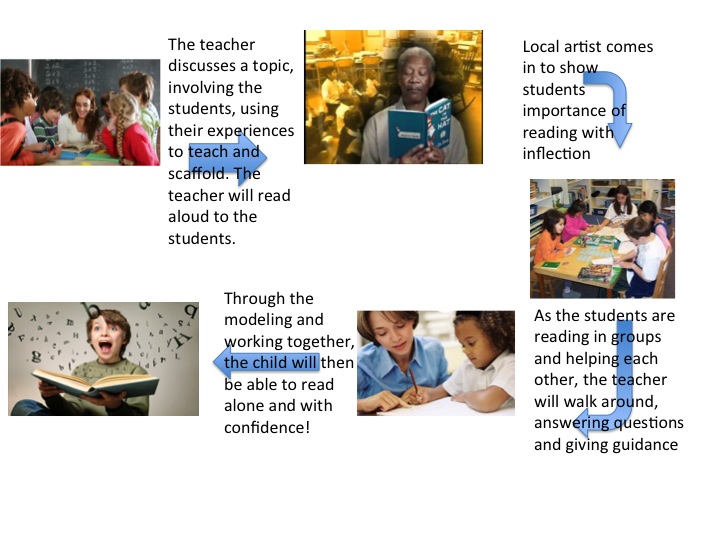
The teacher is working with the class on reading with the
correct inflections. The teacher will
discuss with the class the importance of reading with the correct inflection
and the students will participate fully and answer all of the questions. The teacher will let the students know that
they have already experienced as they read, and they have already witnessed it
when their parents read to them and when she reads them stories. The teacher will then give an example of this
by reading a short story. She will then
give another example of this by inviting a local artist (not Morgan Freeman) to
talk about the significance of reading with inflection and why it is important
to do it. The students will then read to
each other and get input and then get input from the teacher and the local
artist. The student will be assessed by
reading aloud to the class and showing that they can read with inflection.
Explanation:
I kept my model almost the same, except I decided to add a
local actor to come visit the class, because the local actor can show the
students a real life reason why they want to be able to read aloud with
accurate inflection. This activity has
some aspects of it that are supported by Vygotsky’s Sociocultural Theory. One aspect that coincides is the fact that I
am recognizing that children are “social beings, intertwined with other people
who are eager to help them gain skills and understanding” (161). I am doing this by letting the students
discuss with their teacher, a local actor, and their fellow classmates. This way, they actually have an opportunity
to discuss what they are learning and determine if they understand everything
that the teacher and local actor discussed.
This also allows children to be the teacher as well, and this “inclination
to teach and to learn from teaching is what enables children to be socialized
into their culture and to pass it on to others” (162). This
way the children can learn from each other and understand the concepts more
fully as they explain them to their fellow classmates and critique their
classmates’ readings. This will also
allow students to use social scaffolding, because they will be able to see
their fellow students reading at a higher level since I have my classroom
organized into pods where there are varying reading levels in each pod. This way, the students will “become capable
of working at a higher level than if they had not received such help”
(164). My activity also coincides with
Vygotsky’s zone of proximal development (ZPD) because the students will be
exposed to a higher level of reading, but it will not be out of their reach,
because the classmates are in the same grade, thus should be within a couple of
reading levels, with a few outliers of course.


